

 Posts
Posts


Wednesday, September 30, 2009
Prodigal Man
Lewis Black draws dark comedy from religion past and present for second book of observations.
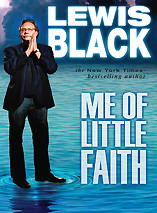 “Me of Little Faith
 ,” comedian Lewis Black’s sequel to his 2005 book, “Nothing’s Sacred,” focuses on just one topic, religion, throughout. Black’s first book mined autobiography for laughs, covering a wide range of experiences from his life. “Faith” does the inverse, using religion as the prism through which Black tells various funny stories and shares observations.
Mind you, Black’s writing, even more so in this book, is designed to jump off the page, a written equivalent of the unique screaming rants he uses in his stand-up performances.
As many Jews are, especially Jewish comedians, Black is hardest on his own religious brethren before throwing stones at anyone else. A highlight of the book comes early on as Black professes bafflement at the rules of Orthodox Judaism. “Here’s the deal breaker as far as I’m concerned. You can’t put cheese in your roast beef sandwich. For God’s sake, I thought Atkins had a lot of rules. … It seems to me that if people follow all the rules to be an Orthodox Jew, they should get to go to heaven without question, even if they are pricks. Because if you can follow all those rules, chances are you are going to be a prick.”
The chapters of “Me of Little Faith” are short and sweet, some just two or three pages. One chapter that is another highlight of the book, “The Rapture,” is particularly effective in its brevity. In it, Black muses on whether Jesus could really get noticed in the Second Coming through all the distractions of modern life, online and off. “He might even have to get the attention he is looking for by immediately going into rehab. He could say that returning was a real shock to his system and so he started self-medicating on various painkillers and cheap red wine.”
Black has plenty of life experience to draw from for a few more serious thoughts on religion, particularly a time in the 1970s when one of his friends went off to follow a guru and Black later visited him at the guru’s farm community in Tennessee. “What we saw was less about divinity than it was about hundreds of people pumping the purest energy of attention toward Stephen [Gaskill] and hence a white light pops out of his head. … As sad as I was to say good-bye to Cliff … I was overjoyed to be returning to the material world. Without my even suggesting it, as soon as we left the Farm, Jeff stopped at the first restaurant we saw. It was one of the best burgers I have ever eaten.”
The latter stretches of “Me of Little Faith” take on recent history and topical stories concerning religion, including his takes on Mormonism, the Amish, sightings of Jesus images in inanimate objects, and a retrospective about evangelists upright and crooked. For one, “When Jewish organizations characterized [Billy Graham’s] quotes as anti-Semitic, Graham defended himself by saying he may have been sucking up to Nixon. Oh, brother. Why would someone who knew God On High feel the need to personally suck up to a guy like Nixon?”
“Me of Little Faith” does careen from one thought to another in less linear fashion than “Nothing’s Sacred,” but it still passes the test for books by comedians -- delivering something more than a re-hash of a stand-up act or being just a show-biz memoir. At times, it even delivers a little profundity amid the laughs as well. It also makes you eager to see what Black will tackle for number three.
“Me of Little Faith,” comedian Lewis Black’s sequel to his 2005 book, “Nothing’s Sacred,” focuses on just one topic, religion, throughout. Black’s first book mined autobiography for laughs, covering a wide range of experiences from his life. “Faith” does the inverse, using religion as the prism through which Black tells various funny stories and shares observations.Mind you, Black’s writing, even more so in this book, is designed to jump off the page, a written equivalent of the unique screaming rants he uses in his stand-up performances.
As many Jews are, especially Jewish comedians, Black is hardest on his own religious brethren before throwing stones at anyone else. A highlight of the book comes early on as Black professes bafflement at the rules of Orthodox Judaism. “Here’s the deal breaker as far as I’m concerned. You can’t put cheese in your roast beef sandwich. For God’s sake, I thought Atkins had a lot of rules. … It seems to me that if people follow all the rules to be an Orthodox Jew, they should get to go to heaven without question, even if they are pricks. Because if you can follow all those rules, chances are you are going to be a prick.”
The chapters of “Me of Little Faith” are short and sweet, some just two or three pages. One chapter that is another highlight of the book, “The Rapture,” is particularly effective in its brevity. In it, Black muses on whether Jesus could really get noticed in the Second Coming through all the distractions of modern life, online and off. “He might even have to get the attention he is looking for by immediately going into rehab. He could say that returning was a real shock to his system and so he started self-medicating on various painkillers and cheap red wine.”
Black has plenty of life experience to draw from for a few more serious thoughts on religion, particularly a time in the 1970s when one of his friends went off to follow a guru and Black later visited him at the guru’s farm community in Tennessee. “What we saw was less about divinity than it was about hundreds of people pumping the purest energy of attention toward Stephen [Gaskill] and hence a white light pops out of his head. … As sad as I was to say good-bye to Cliff … I was overjoyed to be returning to the material world. Without my even suggesting it, as soon as we left the Farm, Jeff stopped at the first restaurant we saw. It was one of the best burgers I have ever eaten.”
The latter stretches of “Me of Little Faith” take on recent history and topical stories concerning religion, including his takes on Mormonism, the Amish, sightings of Jesus images in inanimate objects, and a retrospective about evangelists upright and crooked. For one, “When Jewish organizations characterized [Billy Graham’s] quotes as anti-Semitic, Graham defended himself by saying he may have been sucking up to Nixon. Oh, brother. Why would someone who knew God On High feel the need to personally suck up to a guy like Nixon?”
“Me of Little Faith” does careen from one thought to another in less linear fashion than “Nothing’s Sacred,” but it still passes the test for books by comedians -- delivering something more than a re-hash of a stand-up act or being just a show-biz memoir. At times, it even delivers a little profundity amid the laughs as well. It also makes you eager to see what Black will tackle for number three.
Tuesday, September 29, 2009
 International Society for Krishna Consciousness, ISKCON (a religious sect founded in the United States in 1966; based on Vedic scriptures; groups engage in joyful chanting of `Hare Krishna' and other mantras based on the name of the Hindu god Krishna; devotees usually wear saffron robes and practice vegetarianism and celibacy)
"We're another religious youth group that claims to have all the answers and knows the meaning of life, right? What makes us so special?
Well, we take guidance from a chain of teachers originating from God, or Krishna. Each teacher, in turn, took disciples, or students, and passed on the knowledge of spiritual reality. The support of scriptures ensures that the teachings remain the same. With a large body of detailed sacred texts on many aspects of reality, we're able to harmonise[sic] the variety of beliefs in the world. We can answer just about any question you fire at us. Our programmes[sic] are run by youth, so answers are communicated in a way that makes sense to youth.
 Whether you're wondering how various yoga systems are related or whether it's necessary to worship many gods, or you want to know why bad things happen to good people, come to our sessions and see how deep the rabbit hole really goes!"
One day the zoo-keeper noticed that the orangutan was reading two books - the Bible and Darwin's Origin of Species.
Surprised, he asked the ape, "Why are you reading both those books?"
"Well," said the orangutan, "I just wanted to know if I was my brother's keeper or my keeper's brother."
Monday, September 28, 2009
The most prominent religious picture in which God does not figure at all is, of course, the Buddhist religion. This religion can be characterized not only as non-theistic but more so as atheistic; that is to say, not only does the Buddhist religion discard the notion of God as a religious term, but it vehemently rejects any use of this notion as meaningless. Buddhism is, therefore, a religion without God.
 Believe nothing, o monks,
merely because you have been told it ...
or because it is traditional,
or because you yourselves have imagined it. Do not believe what your teacher tells you
merely out of respect for the teacher.
But whatsoever, after due examination and analysis,
you find to be conducive to the good,
the benefit, the welfare of all beings
that doctrine believe and cling to,
and take it as your guide.
- Gautama Buddha
First Atheist writers
Most histories of atheism choose the Greek and Roman philosophers Epicurus, Democritus, and Lucretius as the first atheist writers. While these writers certainly changed the idea of God, they didn't entirely deny that gods could exist.
Epicurus
 Epicurus put forward the theory of "materialism": The only things that exist are bodies and the space between them. Epicurus taught that the soul is also made of material objects, and so when the body dies the soul dies with it. There is no afterlife.
Epicurus thought that gods might exist, but if they did, they did not have anything to do with human beings.
Religion was the human activity of trying to live in the way such noble (but unknowable) gods might live.
The soul cannot survive separation from the body, since it is necessary to understand that it too is a part.
By itself the soul cannot ever either exist (even though Plato and the Stoics talk a great deal of nonsense on the subject) or experience movement, just as the body does not possess sensation when the soul is released from it.
Lucretius

He followed the same materialist lines as Epicurus, and by denying that the gods had any way of influencing our world he said that humankind had no need to fear the supernatural.
Quotations On The Nature Of Things
This terror, then, this darkness of the mind,
Not sunrise with its flaring spokes of light,
Nor glittering arrows of morning can disperse,
But only Nature's aspect and her law,
Which, teaching us, hath this exordium:
Nothing from nothing ever yet was born.
Fear holds dominion over mortality
Only because, seeing in land and sky
So much the cause whereof no wise they know,
Men think Divinities are working there.
Meantime, when once we know from nothing still
Nothing can be create, we shall divine
More clearly what we seek: those elements
From which alone all things created are,
And how accomplished by no tool of Gods."
He wandered the unmeasurable All.
Whilst human kind
Throughout the lands lay miserably crushed
Before all eyes beneath Religion- who
Would show her head along the region skies,
Glowering on mortals with her hideous face-
A Greek it was who first opposing dared
Raise mortal eyes that terror to withstand,
Whom nor the fame of Gods nor lightning's stroke
Nor threatening thunder of the ominous sky
Abashed; but rather chafed to angry zest
His dauntless heart to be the first to rend
The crossbars at the gates of Nature old.
And thus his will and hardy wisdom won;
And forward thus he fared afar, beyond
The flaming ramparts of the world, until
Whence he to us, a conqueror, reports
What things can rise to being, what cannot,
And by what law to each its scope prescribed,
Its boundary stone that clings so deep in Time.
Wherefore Religion now is under foot,
And us his victory now exalts to heaven.
Attending a wedding for the first time, a
little girl whispered to her mother,
'Why is the bride dressed in white?'
'Because white is the color of happiness,
and today is the happiest day of her life,'
her mother explained, keeping it simple.
The child thought for a moment and said,
'So why is the groom wearing black?'
Sunday, September 27, 2009
Rene Girard Mimetic Thoery and Why People Think Atheists are Immoral.
Posted by theGODscam at 9:38 AM Mimetic Theory states that humans desire things because other humans desire it. This leads to humans fighting over the desired thing, whether that's an ELMO doll or father/son rivalry over the love of a mother.
People who think Atheists must not have any morality don't understand that not only is covetous desire but compassion and a sense or morality are also hard wired in every brain from a evolutionary process. They think atheists are psychopathic or sociopathic people.
Actually, they must think ALL people are psychopathic and only fear of GOD will keep us from rape and murder. Original sin really makes people into self haters doesn't it? And when you hate yourself, you need someone better to tell you what to do. What a great marketing scam.
1.)Create problem "Humans are doomed to do evil things"
2.)Create solution "Jesus (Buddha, Krishna, Mohamed, etc...) as a transcendent role model"
3.)Insert a priest class to intermediate between your hero and yourself.
4.)Market for money "Come to Church!"
The problem is not knowing MIMETIC THEORY and understanding it is a NEUROLOGICAL EFFECT of our brains and that knowing this frees us from it. Jesus is a great example of this. The mythological character of Jesus inspires many people who in no way think he is real, much like Henry V as created by Shakespeare. Historic person converted to transcendent role model. Obvious really...
Here is a seven part video class on Mimetic Theory. Below that is a great article for a quicker overview.
An Interview with Rene Girard
by Brian McDonald
 Rene Girard is both one of the twentieth century’s most prominent theorists of culture and a devout Roman Catholic. Born and raised in France, Girard received his Ph.D. in history from Indiana University and has lived and taught for most of his life in America.
He combines a “deconstructionist” and “debunking” analysis of the origins and bases of human culture with an essentially traditionalist affirmation of Christianity. His cultural analysis has been praised by secular critics, even as his insistence that this very analysis should lead to Christian affirmation has shocked them. Christians are pleased that a giant of modernist and postmodernist thought is a solid Christian, but some are disturbed that he seems to “debunk” the propitiatory view of Christ’s death on the Cross. A brief outline of his thought and its development may therefore be useful before presenting the interview.
Girard’s Thought
Picture two young children playing happily on their porch, a pile of toys beside them. The older child pulls a G.I. Joe from the pile and immediately, his younger brother cries out, “No, my toy!”, pushes him out of the way, and grabs it. The older child, who was not very interested in the toy when he picked it up, now conceives a passionate need for it and attempts to wrest it back. Soon a full fight ensues, with the toy forgotten and the two boys busy pummeling each other.
As the fight intensifies, the overweight child next door wanders into their yard and comes up to them, looking for someone to play with. At that point, one of the two rivals looks up and says, “Oh, there’s old fat butt!” “Yeah,” says his brother. “Big fat butt!” The two, having forgotten the toy, now forget their fight and run the child back home. Harmony has been restored between the two brothers, though the neighbor is now indoors crying.
It would not be much of an exaggeration to say that Girard builds his whole theory of human nature and human culture through a close analysis of the dynamics operating in this story. Most human desires are not “original” or spontaneous, he argues, but are created by imitating another whom he calls the “model.” When the model claims an object, that tells another that it is desirable—and that he must have it instead of him. Girard calls this “mimetic” (or imitative) desire. In the subsequent rivalry, the two parties will come to forget the object and will come to desire the conflict for itself. Harmony will only be restored if the conflicting parties can vent their anger on a common enemy or “scapegoat.”
With the lucidity characteristic of French thought before the “deconstructionist” writers, and a consistency reminiscent of Calvin, Girard shows, throughout the body of his work, how his theory of “mimetic” desire can illuminate and unify an extraordinarily disparate set of human phenomena. It can explain everything from sacrifice to conflict, from mythology to Christianity.
Mimetic desire accounts for the nature of human culture. Early human cultures, thinks Girard, must have been marked by violence as mimetic desire drew human beings into unceasing conflict. Ultimately, the object would disappear from view and be replaced by the conflict itself. Thus, most conflicts, either ancient or modern, are almost literally over “nothing,” with essentially identical rivals seeking only the prestige that comes from achieving victory over each other. (St. Augustine noted this in his Confessions, when he analyzed sports and games and marveled that the only object won in these contests was prestige gained through victory over a rival.)
Primitive societies would have few mechanisms for containing the spreading contagion of mimetic violence, so Girard concludes that such societies would have inevitably decimated themselves had they not found a mechanism for containing the conflict.
This mechanism he locates in another fundamental human characteristic: our propensity for “scapegoating.” At some stage in a cycle of mimetic violence, the community spontaneously turns on one of its members as the one who is to blame for it all. (Remember that point in innumerable movie Westerns where, in the midst of some scene of agitation and confusion, a finger gets pointed at someone and immediately a thicket of fingers is pointing at him and a lynch mob is instantly created?)
While mimetic violence divides each against each, scapegoating violence unites all against one. Thus the destruction of the scapegoat produces a genuinely unifying experience, the peace and relief of which makes such a profound impact that, over time, the hated scapegoat is turned into a god, and the community tries to perpetuate the peace-bringing effect of this original lynching by commemorating it ritually and sacrificially. Ultimately this ritualized violence becomes the basis for religion, mythology, kingship, and the establishment of those differences in role and status that are so essential to bring about internal peace.READ THE FULL INTERVIEW HERE:
http://www.touchstonemag.com/archives/article.php?id=16-10-040-i
Saturday, September 26, 2009
Ben Stein's EXPELLED. A great little showing of how ignorant of science Ben Stein is. "DARWINIST SAY GRAVITY EVOLVED RANDOMLY" What the HELL are you talking about?!?!
Posted by theGODscam at 11:24 PM
Boiling this down REALLY
condenses the crazy.
Its like when you see a really great movie.. then you try to tell someone the plot and its comes out sounding ridiculously silly.
Thursday, September 24, 2009

SOURCE: http://en.wikipedia.org/wiki/Religiosity_and_intelligence#Studies_comparing_religious_belief_and_I.Q.


A debate between a scientist and a Qur'an believing Muslim over whether the Earth is flat or spherical.
Richard Dawkins in a complete and utter debunking of Islamic creationist Harun Yahya's (Adnan Oktar) book "Atlas of Creation". This video is truly Dawkins at his best.

Little is known about general views of evolution in Muslim countries. A 2007 study of religious patterns found that only 8% of Egyptians, 11% of Malaysians, 14% of Pakistanis, 16% of Indonesians, and 22% of Turks agree that Darwin's theory is probably or most certainly true, and a 2006 survey reported that about a quarter of Turkish adults agreed that human beings evolved from earlier animal species.
In contrast, the 2007 study found that only 28% of Kazakhs thought that evolution is false; this fraction is much lower than the roughly 40% of U.S. adults with the same opinion (though this could be due to the fact that Kazakhstan is a former republic of the USSR, where Atheism was explicitly endorsed and promoted).[1]
 In Turkey, polemics against the theory of evolution have been waged by the Nurculuk movement of Said Nursi since the late 1970s. At present, its main exponent[2] is the writer Harun Yahya (pseudonym of Adnan Oktar) who uses the Internet as one of the main methods for the propagation of his ideas.[3] His BAV (Bilim Araştırma Vakfı/ Science Research Foundation) organizes conferences with leading American creationists. Another leading Turkish advocate of Islamic creationism is Fethullah Gülen. Due to the lack of a detailed account of creation in the Qur'an, other aspects than the literal truth of the scripture are emphasized in the Islamic debate.
The most important concept is the idea that there is no such thing as a random event, and that everything happens according to God's will. This does not mean that God has to interfere with the universe and it is ok to believe God set the universe in motion. Hence the ideas of some Islamic creationists are closer to Intelligent design than to Young Earth Creationism. Another Muslim viewpoint is that evolution is real and that God did create it by creating the universe.
According to Guardian some British Muslim students quote the Qu'ran in scientific exams and fail as a result.[4] At a conference in the UK in January, 2004, entitled Creationism: Science and Faith in Schools, Dr Khalid Anees, president of the Islamic Society of Britain stated that "Muslims interpret the world through both the Koran and what is tangible and seen. There is no contradiction between what is revealed in the Quran and natural selection and survival of the fittest."[5] However, over 1,505 people opposed the creationist movement and the Brown government has recently published new standards removing creationism from the schools.
In contrast, the 2007 study found that only 28% of Kazakhs thought that evolution is false; this fraction is much lower than the roughly 40% of U.S. adults with the same opinion (though this could be due to the fact that Kazakhstan is a former republic of the USSR, where Atheism was explicitly endorsed and promoted).[1]
 In Turkey, polemics against the theory of evolution have been waged by the Nurculuk movement of Said Nursi since the late 1970s. At present, its main exponent[2] is the writer Harun Yahya (pseudonym of Adnan Oktar) who uses the Internet as one of the main methods for the propagation of his ideas.[3] His BAV (Bilim Araştırma Vakfı/ Science Research Foundation) organizes conferences with leading American creationists. Another leading Turkish advocate of Islamic creationism is Fethullah Gülen. Due to the lack of a detailed account of creation in the Qur'an, other aspects than the literal truth of the scripture are emphasized in the Islamic debate.
 The most important concept is the idea that there is no such thing as a random event, and that everything happens according to God's will. This does not mean that God has to interfere with the universe and it is ok to believe God set the universe in motion. Hence the ideas of some Islamic creationists are closer to Intelligent design than to Young Earth Creationism. Another Muslim viewpoint is that evolution is real and that God did create it by creating the universe.
According to Guardian some British Muslim students quote the Qu'ran in scientific exams and fail as a result.[4] At a conference in the UK in January, 2004, entitled Creationism: Science and Faith in Schools, Dr Khalid Anees, president of the Islamic Society of Britain stated that "Muslims interpret the world through both the Koran and what is tangible and seen. There is no contradiction between what is revealed in the Quran and natural selection and survival of the fittest."[5] However, over 1,505 people opposed the creationist movement and the Brown government has recently published new standards removing creationism from the schools.

Wednesday, September 23, 2009
A lovely science page for kids of all ages to learn about how we all got here, and how we lived with those big lizards who loved us and only ate grass. Ah the good old days.
Thanks www.CHRISTIANSWERS.net!
God made him from dust. He wasn't a monkey, he looked just like us. Although some scientists don't think it was so, It was God who was there, and He ought to know.. |  |
a book God did give, To tell where we came from and how we should live. We did not evolve, God made it so plain, People are people, we stay just the same. | 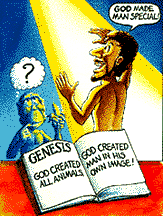 |
 | God made them all, Some rather little, but others quite tall. He said unto Adam, "What names do you think?" Adam then named them, quick as a wink. |  |
Dodo and Deer, Like all of the animals, no man did they fear. But even though all was in true harmony, Adam then realized, "There's no one like me!" | 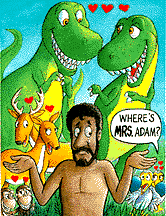 |
"Student Excercise:
Evolutionists indoctrinate us to think that apes and monkeys are very similar to us. Actually, if we did not grow up with this type of brainwashing, we would not think them to be similar nearly as much as we do. They are very different in many respects, though more similar to us than other creatures. Have the children work from photographs, or preferably, go to a zoo; have them write down all the differences they see between animals such as apes and themselves. Then emphasize these differences. You can also mention there are some things that are similar-which is what we would expect from a common Creator. Instead, tell them that the differences show us clearly that we are not related to them.
Hint: Look for differences such as: apes cannot speak; their feet are more like hands; they may use a stick as a sort of tool, but they never use a tool to make a tool like humans can; they walk differently, etc."

(Sizes shown are approximate estimates, and are here mainly for the purpose of ordering the groups, not providing a definitive number. This list is sociological/statistical in perspective.)
1. Christianity: 2.1 billion
2. Islam: 1.5 billion
3. Secular/Nonreligious/Agnostic/Atheist: 1.1 billion
4. Hinduism: 900 million
5. Chinese traditional religion: 394 million
6. Buddhism: 376 million
7. primal-indigenous: 300 million
8. African Traditional & Diasporic: 100 million
9. Sikhism: 23 million
10. Juche: 19 million
11. Spiritism: 15 million
12. Judaism: 14 million
13. Baha'i: 7 million
14. Jainism: 4.2 million
15. Shinto: 4 million
16. Cao Dai: 4 million
17. Zoroastrianism: 2.6 million
18. Tenrikyo: 2 million
19. Neo-Paganism: 1 million
20. Unitarian-Universalism: 800 thousand
21. Rastafarianism: 600 thousand
22. Scientology: 500 thousand
Introduction
The adherent counts presented in the list above are current estimates of the number of people who have at least a minimal level of self-identification as adherents of the religion. Levels of participation vary within all groups. These numbers tend toward the high end of reasonable worldwide estimates. Valid arguments can be made for different figures, but if the same criteria are used for all groups, the relative order should be the same. Further details and sources are available below and in the Adherents.com main database.
A major source for these estimates is the detailed country-by-country analysis done by David B. Barrett's religious statistics organization, whose data are published in the Encyclopedia Britannica (including annual updates and yearbooks) and also in the World Christian Encyclopedia (the latest edition of which - published in 2001 - has been consulted). Hundreds of additional sources providing more thorough and detailed research about individual religious groups have also been consulted.
This listing is not a comprehensive list of all religions, only the "major" ones (as defined below). There are distinct religions other than the ones listed above. But this list accounts for the religions of over 98% of the world's population. Below are listed some religions which are not in this listing (Mandeans, PL Kyodan, Ch'ondogyo, Vodoun, New Age, Seicho-No-Ie, Falun Dafa/Falun Gong, Taoism, Roma), along with explanations for why they do not qualify as "major world religions" on this list.
This world religions listing is derived from the statistics data in the Adherents.com database. The list was created by the same people who collected and organized this database, in consultation with university professors of comparative religions and scholars from different religions. We invite additional input. The Adherents.com collection of religious adherent statistics now has over 43,000 adherent statistic citations, for over 4,300 different faith groups, covering all countries of the world. This is not an absolutely exhaustive compilation of all such data, but it is by far the largest compilation available on the Internet. Various academic researchers and religious representatives regularly share documented adherent statistics with Adherents.com so that their information can be available in a centralized database.

Tuesday, September 22, 2009
Natural Selection Created Religion: Philosopher Dan Dennett explains how religion is a mental symbiotic or destructive virus, and why THE PURPOSE DRIVEN LIFE by Rick Warren is so popular.
Posted by theGODscam at 7:10 PMPhilosopher Dan Dennett calls for religion -- all religion -- to be taught in schools, so we can understand its nature as a natural phenomenon. Then he takes on The Purpose-Driven Life, disputing its claim that, to be moral, one must deny evolution.


Daniel Clement Dennett (born March 28, 1942 in Boston, Massachusetts) is a prominent American philosopher whose research centers on philosophy of mind, philosophy of science and philosophy of biology, particularly as those fields relate to evolutionary biology and cognitive science. He is currently the co-director of the Center for Cognitive Studies, the Austin B. Fletcher Professor of Philosophy, and a University Professor at Tufts University. Dennett is also a noted atheist and advocate of the Brights movement.
Daniel Dennet's Homepage: http://ase.tufts.edu/cogstud/incbios/dennettd/dennettd.htm
Some of his FANTASTIC books:
Some of his FANTASTIC books:


By Cathy Lynn Grossman, USA TODAY
Americans who don't identify with any religion are now 15% of the USA, but trends in a new study shows they could one day surpass the nation's largest denominations — including Catholics, now 24% of the nation.
American Nones: Profile of the No Religion Population, to be released today by Trinity College, finds this faith-free group already includes nearly 19% of U.S. men and 12% of women. Of these, 35% say they were Catholic at age 12.
FAITH & REASON: What's your religious path: Any, many, one or none?
"Will a day come when the Nones are on top? We can't predict for sure," says lead researcher Barry Kosmin.
But if Nones, now 22% of all adults ages 18 to 29, continue to gain among young adults, to draw more people "switching out" from denominations and to replace more religious older people, researchers forecast one in five Americans will be Nones in 20 years.
"Trends clearly favor this," Kosmin says. But he also notes, "There could be a Great Awakening (massive Protestant revival) or immigration may bring in more Catholic believers."
Kosmin and Ariela Keysar of Trinity College, Hartford, Conn., directed three editions of the American Religious Identification Survey over 18 years. The 2008 ARIS (pdf), based on a sampling of 54,000 U.S. adults, also burrowed in for a closer look at 1,106 Nones, who answered extra questions about their beliefs and behaviors and views on God.
ARIS: Most religious groups have lost ground in USA
'NONES': Now 15% of population
The report finds:
•Not all Nones are alike. Half (51%) still believe in God or a higher power.
•Nones also are the only major U. S. faith group that's majority male. Even when girls grow up with unbelieving parents, they're more likely to find a faith as adults than their brothers.
"Women are also less skeptical than men and less drawn to irreligious and anti-religious views. They are more likely to reject a secular upbringing," Kosmin says.
"There is a lot of 'churning' going on but Nones gain much more from switching (people leaving religion) than from natural growth (children emulating unbelieving parents)," he says.
•The percentage of atheist Nones — who say there's no such thing as God — hasn't budged in years.

"It's not as though dozens of people at the Methodist Church read (atheist Richard) Dawkins and suddenly decided God doesn't exist," says Kosmin.
"There are so many misconceptions about who the Nones are. They're not New Age searchers or spiritual or even hardened atheists," says Kosmin.
"They're a stew of agnostics, deists and rationalists. They sound more like Thomas Jefferson and Tom Paine. Their very interesting enlightenment approach is like the Founding Fathers' kind: Skeptical about organized religion and clerics while still holding to an idea of God."
One quirky fact: 33% of Nones claim Irish ancestry, although the U.S. Census says only 10% of the USA does.
"We have no idea why," he says. "Maybe you could ask (Fox newscaster) Bill O'Reilly.
In some way, researchers found Nones are very much like the overall, largely religious, U.S. population. There's no statistical difference on education, or income or marital status. They are just as likely to be divorced as anybody else.
"Nones are not a fringe group anymore and are now part of Middle America. They're present in every socio-demographic group, Keysar concludes in their report.
Monday, September 21, 2009

The prestigious magazine, Scientific American, published figures showing that while 90% of the general American public believes in a personal God and an afterlife, only 40% of scientists who are BS-degree-only holders so believe and only 10% of scientists regarded as eminent believe in a personal God or an afterlife.
In a survey of more than 500 members of the National Academy of Scientists, it was found that 72% were atheists, 21% were agnostics and 7% believed in God. A very similar breakdown was found in relation to belief in an afterlife.
Results of a survey published in Skeptic magazine the same year showed that about 40% of scientists in general believed in God. In particular, 40% of mathematicians, 30% of biologists and 20% of physicists were believers, according to the study. These figures tend to agree with the Scientific American figures for BS-holders, while the figures for the NAS correspond more closely with the Scientific American figures for eminent scientists, as would be expected.

This is a direct quotation from Free Inquiry magazine, 1986: "Is it more logical to be a Christian? Is religion the natural choice of a smart person familiar with more of the evidence? Not according to a broad consensus of studies on IQ and religiosity. These studies have consistently found that the lower the IQ score, the more likely a person is to be religious."
A Gallup poll found that 33% of college graduates believe in creationism, while 55% of high-school-only graduates and 66% of grade- school-only graduates believe in creationism, that is, the belief that God created Adam and Eve, the mythical parents of the human race.
Another Gallup poll showed that 53% of college graduates and 63% of non-graduates considered religion very important in their lives, while 48% of Americans in the $50,000-and-up income range, 56% in the $20,000--$50,000 range and 66% in the less-than-$20,000 range considered religion very important.
These figures agree with my own observations. Most of the educated people I've met, and especially those of a scientific bent, tend to have open, inquiring minds, whereas ordinary people on the street, like bus drivers, supermarket checkers, telemarketers, bakers and carpenters most often declare themselves Christians, often stubbornly and peevishly.

I've seen in a few articles on Internet and elsewhere that people like these have derided atheistic scientists as "absent-minded professors" and worse. But consider some of the things that modern science has produced: computers, television, electricity, nuclear energy, airplanes, cell phones, spaceships, audio- video equipment, automobiles, X-rays, copiers, fax machines, printing presses, plastics, petroleum refineries, power stations and modern ships.
What can religion offer? Prayer books? Rosaries? Crucifixes? Icons? Habits? Scriptures?
All of the above figures definitely correlate education and intelligence with disbelief in religion, and ignorance and lack of intelligence with religion. This correlation is also self- evident from the fact that in the Middle Ages, when educational levels were low, religion was in its heyday, whereas nowadays, when education is greatly improved, religion is beginning to decline. All and all, I think it's safe to say that Christians are intellectually inferior to atheists.
By Thomas Keyes
Source: http://www.useless-knowledge.com/1234/feb/article156.html
In a survey of more than 500 members of the National Academy of Scientists, it was found that 72% were atheists, 21% were agnostics and 7% believed in God. A very similar breakdown was found in relation to belief in an afterlife.
Results of a survey published in Skeptic magazine the same year showed that about 40% of scientists in general believed in God. In particular, 40% of mathematicians, 30% of biologists and 20% of physicists were believers, according to the study. These figures tend to agree with the Scientific American figures for BS-holders, while the figures for the NAS correspond more closely with the Scientific American figures for eminent scientists, as would be expected.

A Gallup poll found that 33% of college graduates believe in creationism, while 55% of high-school-only graduates and 66% of grade- school-only graduates believe in creationism, that is, the belief that God created Adam and Eve, the mythical parents of the human race.
Another Gallup poll showed that 53% of college graduates and 63% of non-graduates considered religion very important in their lives, while 48% of Americans in the $50,000-and-up income range, 56% in the $20,000--$50,000 range and 66% in the less-than-$20,000 range considered religion very important.
These figures agree with my own observations. Most of the educated people I've met, and especially those of a scientific bent, tend to have open, inquiring minds, whereas ordinary people on the street, like bus drivers, supermarket checkers, telemarketers, bakers and carpenters most often declare themselves Christians, often stubbornly and peevishly.

What can religion offer? Prayer books? Rosaries? Crucifixes? Icons? Habits? Scriptures?
All of the above figures definitely correlate education and intelligence with disbelief in religion, and ignorance and lack of intelligence with religion. This correlation is also self- evident from the fact that in the Middle Ages, when educational levels were low, religion was in its heyday, whereas nowadays, when education is greatly improved, religion is beginning to decline. All and all, I think it's safe to say that Christians are intellectually inferior to atheists.
By Thomas Keyes
Source: http://www.useless-knowledge.com/1234/feb/article156.html
Sunday, September 20, 2009

MEASURING SPIRITUAL FORCE

Yet many people seem no more able to have such an experience than to fly to Venus. One explanation came in 1999, when Australian researchers found that people who report mystical and spiritual experiences tend to have unusually easy access to subliminal consciousness. "In people whose unconscious thoughts tend to break through into consciousness more readily, we find some correlation with spiritual experiences," says psychologist Michael Thalbourne of the University of Adelaide. Unfortunately, scientists are pretty clueless about what allows subconscious thoughts to pop into the consciousness of some people and not others. The single strongest predictor of such experiences, however, is something called "dissociation." In this state, different regions of the brain disengage from others. "This theory, which explains hypnotizability so well, might explain mystical states, too," says Michael Shermer, director of the Skeptics Society, which debunks paranormal phenomena. "Something really seems to be going on in the brain, with some module dissociating from the rest of the cortex."
THE NEURAL BASIS FOR RELIGIOUS EXPERIENCE

Interestingly, this region of the brain also seems important for speech perception. One experience common to many spiritual states is hearing the voice of God. It seems to arise when you misattribute inner speech (the "little voice" in your head that you know you generate yourself) to something outside yourself. During such experiences, the brain's Broca's area (responsible for speech production) switches on. Most of us can tell this is our inner voice speaking. But when sensory information is restricted, as happens during meditation or prayer, people are "more likely to misattribute internally generated thoughts to an external source," suggests psychologist Richard Bentall of the University of Manchester in England in the book
"Varieties of Anomalous Experience."
Stress and emotional arousal can also interfere with the brain's ability to find the source of a voice, Bentall adds. In a 1998 study, researchers found that one particular brain region, called the right anterior cingulate, turned on when people heard something in the environment-a voice or a sound-and also when they hallucinated hearing something. But it stayed quiet when they imagined hearing something and thus were sure it came from their own brain. This region, says Bentall, "may contain the neural circuits responsible for tagging events as originating from the external world." When it is inappropriately switched on, we are fooled into thinking the voice we hear comes from outside us.
Even people who describe themselves as nonspiritual can be moved by religious ceremonies and liturgy. Hence the power of ritual. Drumming, dancing, incantations-all rivet attention on a single, intense source of sensory stimulation, including the body's own movements. They also evoke powerful emotional responses. That combination-focused attention that excludes other sensory stimuli, plus heightened emotion-is key. Together, they seem to send the brain's arousal system into hyperdrive, much as intense fear does. When this happens, explains Newberg, one of the brain structures responsible for maintaining equilibrium-the hippocampus-puts on the brakes.
It inhibits the flow of signals between neurons, like a traffic cop preventing any more cars from entering the on-ramp to a tied-up highway.
'SOFTENING OF THE BOUNDARIES OF THE SELF'

Researchers' newfound interest in neurotheology reflects more than the availability of cool new toys to peer inside the working brain. Psychology and neuroscience have long neglected religion. Despite its centrality to the mental lives of so many people, religion has been met by what David Wulff calls "indifference or even apathy" on the part of science. When one psychologist, a practicing Christian, tried to discuss in his introductory psych book the role of faith in people's lives, his publisher edited out most of it-for fear of offending readers. The rise of neurotheology represents a radical shift in that attitude.
And whatever light science is shedding on spirituality, spirituality is returning the favor: mystical experiences, says Forman, may tell us something about consciousness, arguably the greatest mystery in neuroscience. "In mystical experiences, the content of the mind fades, sensory awareness drops out, so you are left only with pure consciousness," says Forman. "This tells you that consciousness does not need an object, and is not a mere byproduct of sensory action."
For all the tentative successes that scientists are scoring in their search for the biological bases of religious, spiritual and mystical experience, one mystery will surely lie forever beyond their grasp. They may trace a sense of transcendence to this bulge in our gray matter.
And they may trace a feeling of the divine to that one. But it is likely that they will never resolve the greatest question of all-namely, whether our brain wiring creates God, or whether God created our brain wiring. Which you believe is, in the end, a matter of faith.
SELF AND NOT-SELF

I felt communion, peace, openness to experience ... [There was] an awareness and responsiveness to God's presence around me, and a feeling of centering, quieting, nothingness, [as well as] moments of fullness of the presence of God. [God was] permeating my being.
This is how her 45-minute prayer made Sister Celeste, a Franciscan nun, feel, just before Newberg SPECT-scanned her. During her most intensely religious moments, when she felt a palpable sense of God's presence and an absorption of her self into his being, her brain displayed changes like those in the Tibetan Buddhist meditators: her orientation area went dark. What Sister Celeste and the other nuns in the study felt, and what the meditators experienced, Newberg emphasizes, "were neither mistakes nor wishful thinking. They reflect real, biologically based events in the brain." The fact that spiritual contemplation affects brain activity gives the experience a reality that psychologists and neuroscientists had long denied it, and explains why people experience ineffable, transcendent events as equally real as seeing a wondrous sunset or stubbing their toes.
PINPOINTING SPIRITUAL EXPERIENCE

I could hear the singing of the planets, and wave after wave of light washed over me. But ... I was the light as well ... I no longer existed as a separate I' ... I saw into the structure of the universe. I had the impression of knowing beyond knowledge and being given glimpses into ALL.
That was how author Sophy Burnham described her experience at Machu Picchu, in her 1997 book "The Ecstatic Journey." Although there was no scientist around to whisk her into a SPECT machine and confirm that her orientation area was AWOL, it was almost certainly quiescent. That said, just because an experience has a neural correlate does not mean that the experience exists "only" in the brain, or that it is a figment of brain activity with no independent reality. Think of what happens when you dig into an apple pie. The brain's olfactory region registers the aroma of the cinnamon and fruit. The somatosensory cortex processes the feel of the flaky crust on the tongue and lips. The visual cortex registers the sight of the pie.
Remembrances of pies past (Grandma's kitchen, the corner bake shop ...) activate association cortices. A neuroscientist with too much time on his hands could undoubtedly produce a PET scan of "your brain on apple pie." But that does not negate the reality of the pie. "The fact that spiritual experiences can be associated with distinct neural activity does not necessarily mean that such experiences are mere neurological illusions," Newberg insists. "It's no safer to say that spiritual urges and sensations are caused by brain activity than it is to say that the neurological changes through which we experience the pleasure of eating an apple cause the apple to exist."
The bottom line, he says, is that "there is no way to determine whether the neurological changes associated with spiritual experience mean that the brain is causing those experiences ... or is instead perceiving a spiritual reality."
PRODUCING VISIONS

Temporal-lobe epilepsy-abnormal bursts of electrical activity in these regions-takes this to extremes. Although some studies have cast doubt on the connection between temporal-lobe epilepsy and religiosity, others find that the condition seems to trigger vivid, Joan of Arc-type religious visions and voices. In his recent book "Lying Awake," novelist Mark Salzman conjures up the story of a cloistered nun who, after years of being unable to truly feel the presence of God, begins having visions.
The cause is temporal-lobe epilepsy. Sister John of the Cross must wrestle with whether to have surgery, which would probably cure her-but would also end her visions. Dostoevsky, Saint Paul, Saint Teresa of Avila, Proust and others are thought to have had temporal-lobe epilepsy, leaving them obsessed with matters of the spirit.
Although temporal-lobe epilepsy is rare, researchers suspect that focused bursts of electrical activity called "temporal-lobe transients" may yield mystical experiences. To test this idea, Michael Persinger of Laurentian University in Canada fits a helmet jury-rigged with electromagnets onto a volunteer's head.
The helmet creates a weak magnetic field, no stronger than that produced by a computer monitor. The field triggers bursts of electrical activity in the temporal lobes, Persinger finds, producing sensations that volunteers describe as supernatural or spiritual: an out-of-body experience, a sense of the divine. He suspects that religious experiences are evoked by mini electrical storms in the temporal lobes, and that such storms can be triggered by anxiety, personal crisis, lack of oxygen, low blood sugar and simple fatigue-suggesting a reason that some people "find God" in such moments. Why the temporal lobes? Persinger speculates that our left temporal lobe maintains our sense of self. When that region is stimulated but the right stays quiescent, the left interprets this as a sensed presence, as the self departing the body, or of God.
Those most open to mystical experience tend also to be open to new experiences generally. They are usually creative and innovative, with a breadth of interests and a tolerance for ambiguity (as determined by questionnaire).
They also tend toward fantasy, notes David Wulff ... I was alone upon the seashore ... I felt that I
... return[ed] from the solitude of individuation into the consciousness of unity with all that is ... Earth, heaven, and sea resounded as in one vast world encircling harmony ... I felt myself one with them.
Is an experience like this one, described by the German philosopher Malwida von Meysenburg in 1900, within the reach of anyone? "Not everyone who meditates encounters these sorts of unitive experiences," says Robert K.C. Forman, a scholar of comparative religion at Hunter College in New York City. "This suggests that some people may be genetically or temperamentally predisposed to mystical ability." Those most open to mystical experience tend also to be open to new experiences generally. They are usually creative and innovative, with a breadth of interests and a tolerance for ambiguity (as determined by questionnaire).
They also tend toward fantasy, notes David Wulff, "suggesting a capacity to suspend the judging process that distinguishes imaginings and real events." Since "we all have the brain circuits that mediate spiritual experiences, probably most people have the capacity for having such experiences," says Wulff. "But it's possible to foreclose that possibility. If you are rational, controlled, not prone to fantasy, you will probably resist the experience."

One Sunday morning in March, 19 years ago, as Dr. James Austin waited for a train in London, he glanced away from the tracks toward the river Thames. The neurologist-
who was spending a sabbatical year in England-saw nothing out of the ordinary: the grimy Underground station, a few dingy buildings, some pale gray sky. He was thinking, a bit absent-mindedly, about the Zen Buddhist retreat he was headed toward. And then
Austin suddenly felt a sense of enlightenment unlike anything he had ever experienced. His sense of individual existence, of separateness from the physical world around him, evaporated like morning mist in a bright dawn. He saw things "as they really are," he recalls. The sense of "I, me, mine" disappeared. "Time was not present," he says. "I had a sense of eternity. My old yearnings, loathings, fear of death and insinuations of selfhood vanished. I had been graced by a comprehension of the ultimate nature of things."
CALL IT A MYSTICAL EXPERIENCE, a spiritual moment, even a religious epiphany, if you like-but Austin will not. Rather than interpret his instant of grace as proof of a reality beyond the comprehension of our senses, much less as proof of a deity, Austin took it as "proof of the existence of the brain." He isn't being smart-alecky. As a neurologist, he accepts that all we see, hear, feel and think is mediated or created by the brain. Austin's moment in the Underground therefore inspired him to explore the neurological underpinnings of spiritual and mystical experience. In order to feel that time, fear and self-consciousness have dissolved, he reasoned, certain brain circuits must be interrupted.
Which ones? Activity in the amygdala, which monitors the environment for threats and registers fear, must be damped. Parietal-lobe circuits, which orient you in space and mark the sharp distinction between self and world, must go quiet. Frontal- and temporal-lobe circuits, which mark time and generate self-awareness, must disengage. When that happens, Austin concludes in a recent paper, "what we think of as our 'higher' functions of selfhood appear briefly to 'drop out,' 'dissolve,' or be 'deleted from consciousness'." When he spun out his theories in 1998, in the 844-page "Zen and the Brain," it was published not by some flaky New Age outfit but by MIT Press. May 2 - Why God Won't Go Away: Brain science and the biology of belief" by Andrew Newberg, M.D.
Since then, more and more scientists have flocked to "neurotheology," the study of the neurobiology of religion and spirituality. Last year the American Psychological Association published "Varieties of Anomalous Experience," covering enigmas from near-death experiences to mystical ones. At Columbia University's new Center for the Study of Science and Religion, one program investigates how spiritual experiences reflect "peculiarly recurrent events in human brains." In December, the scholarly Journal of Consciousness Studies devoted its issue to religious moments ranging from "Christic visions" to "shamanic states of consciousness."

What all the new research shares is a passion for uncovering the neurological underpinnings of spiritual and mystical experiences-for discovering, in short, what happens in our brains when we sense that we "have encountered a reality different from-and, in some crucial sense, higher than-the reality of everyday experience," as psychologist David Wulff of Wheaton College in Massachusetts puts it.
OUTSIDE OF TIME AND SPACE
In neurotheology, psychologists and neurologists try to pinpoint which regions turn on, andwhich turn off, during experiences that seem to exist outside time and space. In this way it differs from the rudimentary research of the 1950s and 1960s that found, yeah, brain waves change when you meditate. But that research was silent on why brain waves change, or which specific regions in the brain lie behind the change.
Neuroimaging of a living, working brain simply didn't exist back then. In contrast, today's studies try to identify the brain circuits that surge with activity when we think we have encountered the divine, and when we feel transported by intense prayer, an uplifting ritual or sacred music.
Although the field is brand new and the answers only tentative, one thing is clear. Spiritual experiences are so consistent across cultures, across time and across faiths, says Wulff, that it "suggest[s] a common core that is likely a reflection of structures and processes in the human brain."
There was a feeling of energy centered within me ... going out to infinite space and returning ... There was a relaxing of the dualistic mind, and an intense feeling of love. I felt a profound letting go of the boundaries around me, and a connection with some kind of energy and state of being that had a quality of clarity, transparency and joy.
I felt a deep and profound sense of connection to everything, recognizing that there never was a true separation at all.
The problem with Neurotheology is that it confuses spiritual experiences with religion That is how Dr. Michael J. Baime, a colleague of Andrew Newberg's at Penn, describes what he feels at the moment of peak transcendence when he practices Tibetan Buddhist meditation, as he has since he was 14 in 1969. Baime offered his brain to Newberg, who, since childhood, had wondered about the mystery of God's existence. At Penn, Newberg's specialty is radiology, so he teamed with Eugene d'Aquili to use imaging techniques to detect which regions of the brain are active during spiritual experiences. The scientists recruited Baime and seven other Tibetan Buddhists, all skilled meditators.
TESTING FOR THE TIMELESS AND INFINITE

afterward, "a part of everyone and everything in existence." When he reached the "peak" of spiritual intensity, he tugged on the twine. Newberg, huddled outside the room and holding the other end, felt the pull and quickly injected a radioactive tracer into an IV line that ran into Baime's left arm. After a few moments, he whisked Baime off to a SPECT (single photon emission computed tomography) machine. By detecting the tracer, it tracks blood flow in the brain. Blood flow correlates with neuronal activity.
Attention: Linked to concentration, the frontal lobe lights up during meditation
Religious emotions: The middle temporal lobe is linked to emotional aspects of religious experience, such as joy and awe
Sacred images: The lower temporal lobe is involved in the process by which images, such as candles or crosses, facilitate prayer and meditation
Response to religious words: At the juncture of three lobes, this region governs response to language Cosmic unity: When the parietal lobes quiet down, a person can feel at one with the universe
The SPECT images are as close as scientists have come to snapping a photo of a transcendent experience. As expected, the prefrontal cortex, seat of attention, lit up: Baime, after all, was focusing deeply. But it was a quieting of activity that stood out. A bundle of neurons in the superior parietal lobe, toward the top and back of the brain, had gone dark. This region, nicknamed the
"orientation association area," processes information about space and time, and the orientation of the body in space.
It determines where the body ends and the rest of the world begins. Specifically, the left orientation area creates the sensation of a physically delimited body; the right orientation area creates the sense of the physical space in which the body exists. (An injury to this area can so cripple your ability to maneuver in physical space that you cannot figure the distance and angles needed to navigate the route to a chair across the room.)
Subscribe to:
Posts (Atom)